
Does our desire to help do more harm than good?
Fast Company July 10th. 2010
In prep for leading a session titled "Getting out of Your Comfort Zone" for Design For America's summer session I found this useful and informative.
Emily Pilloton's Design Revolution Road Show, the physical embodiment of her non-profit Project H Design rolled into New York a few weeks ago stopping at Metropolis, the Cooper Hewitt National Design Museum and ICFF. Yes, Project H is hot in U.S. and European design circles, almost as sizzling as IDEO, the Acumen Fund, and One Laptop Per Child.
And why not? Emily’s Project H is a pure play in using design to do good. It doesn’t get better than this mission statement:
Project H Design connects the power of design to the people who need it most, and the places where it can make a real and lasting difference. We are a team of designers, architects, and builders engaging locally through partnerships with social service organizations, communities, and schools to improve the quality of life for the socially overlooked. Our five-tenet design process (There is no design without action; We design WITH, not FOR; We document, share and measure; We start locally and scale globally, We design systems, not stuff) results in simple and effective design solutions for those without access to creative capital. Our scalable long-term initiatives focus on improving environments, services, products, and experiences for youth and K-12 education institutions in the U.S. through systems-level design thinking and deep community engagements. WE BELIEVE DESIGN CAN CHANGE THE WORLD.
So do I. But whose design? Which solutions? What problems?
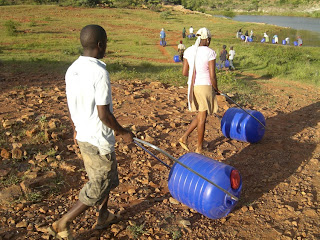
One of Project H's initiatives was to redesign the Hippo Roller, a water transportation device.
Let me explain. The last time I saw Emily was in Singapore in the fall at the ICSID World Design Congress where she was receiving a roaring applause from the European and American designers on stage after giving a speech about Project H. I loved that speech because it linked the power of design to the obligation to do good. In a world awash in consumption, with many designers complicit in designing that consumption, Emily’s message was right on.
But not to the mostly Asian designer audience. Of course there was polite applause but, to my surprise, there was also a lot of loud grumbling against Emily along the lines of "What makes her think she can just come in and solve our problems?” This was a challenge of presumption that just stopped me cold--and sent me back to my Peace Corps days when I heard a lot about Western cultural imperialism from my Filipino friends. Are designers helping the "Little Brown Brothers?" Are designers the new anthropologists or missionaries, come to poke into village life, "understand" it and make it better--their "modern" way?
Naw. I dismissed the rumblings in the audience against Emily and Project H as insignificant. After all, what were those Asian designers doing for their own poor people in villages and towns in India, the Philippines, and China?
Then, some months later at Parsons School for Design, the same thing happened. I went to a talk by IDIOM Design, one of India’s top design consultancies.
Might Indian, Brazilian and African designers have important design lessons to teach Western designers?
At the end of a great presentation, a 20-something woman from the Acumen Fund rushed to the front and said in the proudest, most optimistic, breathless way that Acumen was teaming up with IDEO and the Bill and Melinda Gates Foundation to design better ways of delivering safe drinking water to Indian villagers. She said this to the Indian businessman Kishoreji Biyani, who is the key investor in IDIOM, and to my stunned surprise--and hers--he groused that there was a better, Indian way of solving the problem. She didn't know what to say. And I didn't either.
I know the Acumen and IDEO people and they, like Emily, are the very best. I know the IDIOM folks and they, too, are the very best. And I have met Mr. Biyani in India and he is an amazing businessman. But he, too, like many in the Asian audience in Singapore, took offense at Western design intervention in his country.
So what’s going on? Did what I see in these two occasions represent something wider and deeper? Is the new humanitarian design coming out of the U.S. and Europe being perceived through post-colonial eyes as colonialism? Are the American and European designers presuming too much in their attempt to do good?
As I pondered this, I remembered the contretemps over One Laptop Per Child, an incredibly ambitious project sponsored by all the good guys--the MIT Media Lab, Pentagram, Continuum, fuseproject.
The OLPC XO-3, a touchscreen pad device, is planned to debut in 2012
Again, I know most of the players and they are good souls. The laptop itself is wonderful, with a beautiful shape and unique interface. Yet, OLPC failed in its initial plan to drop millions of inexpensive computers into villages, to hook kids directly to the Web and, in effect, get them to educate themselves. The Indian establishment locked OLPC out precisely because it perceived the effort as inappropriate technological colonialism that cut out those responsible for education in the country—policymakers, teachers, curriculum builders, parents. OLPC never got into China either. Or most of the large nations it had originally targeted.
So where are we with humanitarian design? I know almost all of my Gen Y students want to do it because their value system is into doing good globally. Young designers in consultancies and corporations want to do humanitarian design for the same reason.
But should we take a moment now that the movement is gathering speed to ask whether or not American and European designers are collaborating with the right partners, learning from the best local people, and being as sensitive as they might to the colonial legacies of the countries they want to do good in. Do designers need to better see themselves through the eyes of the local professional and business classes who believe their countries are rising as the U.S. and Europe fall and wonder who, in the end, has the right answers? Might Indian, Brazilian and African designers have important design lessons to teach Western designers?
And finally, one last question: why are we only doing humanitarian design in Asia and Africa and not Native American reservations or rural areas, where standards of education, water and health match the very worst overseas?
Bruce Nussbaum blogs, tweets and writes on innovation, design thinking and creativity. The former assistant managing editor for Business Week is a Professor of Innovation.
 DD+D's Project Bodystorming was featured in Campbell Soup Companies Diversity and Inclusion blog Inclusion to Innovation.




